Why Turkey is Eaten on Thanksgiving? The Tradition Didn’t Start the Way Many Believe
Por Miriam Gonzalez ·
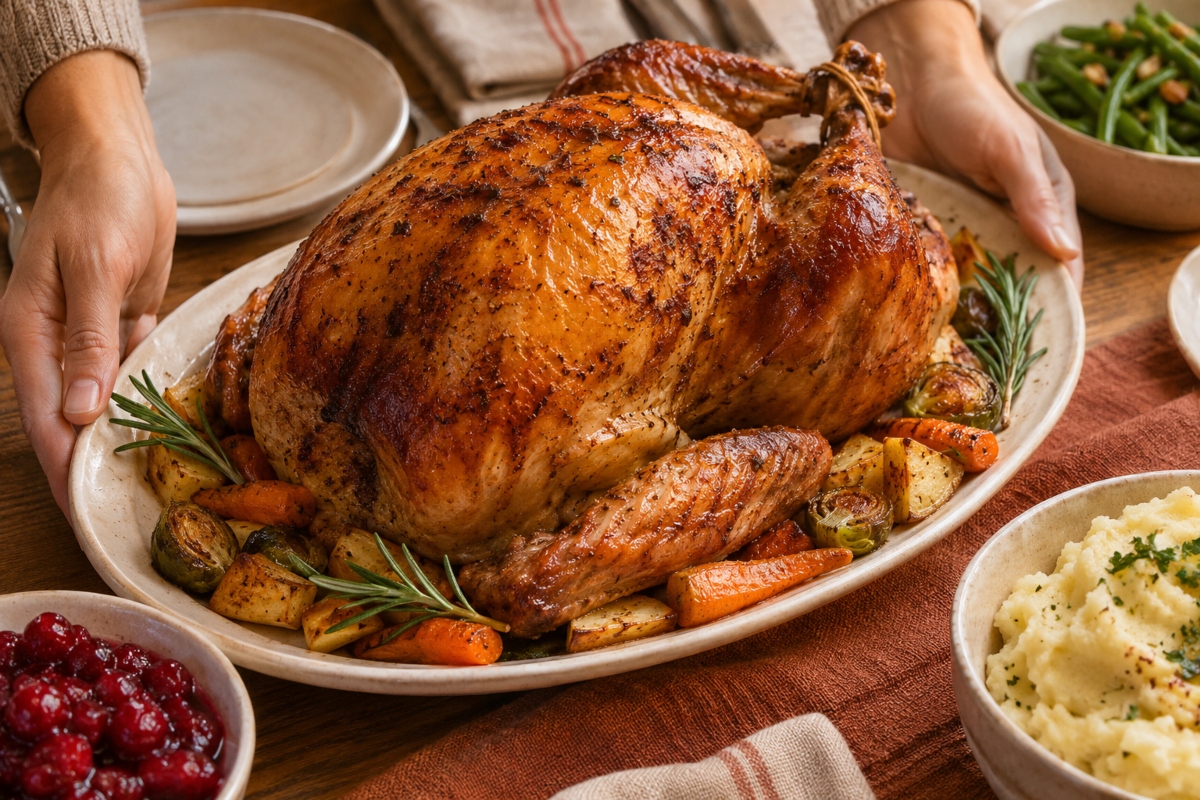
Turkey became the star of the Thanksgiving dinner through a combination of practical reasons and customs spread across generations. Its size allowed it to feed several people, while writers, magazines, and advances in food distribution helped consolidate it as a symbol of Thanksgiving. However, its presence at the 1621 celebration is not confirmed with the precision that popular images suggest.
Although it is difficult to imagine this celebration today without a turkey at the center of the table, the current tradition was built long after the meeting between the Plymouth colonists and the Wampanoag people.
Was There Turkey at the 1621 Meal?
Plimoth Patuxet Museums explains that the only firsthand account mentioning the foods from that celebration records venison and wild birds.
It does not contain a complete menu nor does it describe how all the dishes were prepared.
The word used for the birds does not allow identification of a single species.
It could include turkeys, but also ducks or geese.
Therefore, the available records are not sufficient to ensure that turkey was the main dish.
The Smithsonian’s National Museum of American History notes that these birds were abundant in the Plymouth region.
It also points out that they were not the only ones that could be part of the diet of the time.
The availability of a food, by itself, does not confirm that it was served at a specific gathering.
Turkey on Thanksgiving and the Woman Who Helped Popularize It
The relationship between turkey and the celebration gained strength during the 19th century.
An important figure was Sarah Josepha Hale, a writer and editor who promoted a national Thanksgiving celebration for years.
In her novel Northwood, published in 1827, she described Thanksgiving customs in New England.
Later, through Godey’s Lady’s Book magazine, she promoted a vision of the celebration centered on family gatherings and abundant food, with turkey as a prominent element.
Historian Troy Bickham, from Texas A&M University, explains that this publication and other media spread recipes and menus where the bird held an important place.
That presence helped extend the association between turkey and the celebration.
A Practical Choice for Feeding Many
The size of the turkey also favored its popularity.
Compared to smaller birds, it allowed serving a large group, an advantage for a celebration organized around a shared table.
Furthermore, a whole roasted bird offered an appropriate presentation for a special occasion.
Bickham identifies both its usefulness for feeding several people and its appearance as a festive centerpiece among the reasons that explain its consolidation.
Later, poultry production and frozen food transportation made its distribution easier.
Anthropologist Elan Abrell, consulted by HISTORY, points out that these changes contributed to spreading the custom beyond its regional scope.
The Current Dinner Tells a Story of Change
The contemporary menu should also not be understood as a copy of the 1621 meal.
Plimoth Patuxet Museums distinguishes between the few documented foods and the set of preparations that were incorporated over the following centuries.
Thus, the explanation for why turkey is eaten brings together availability, size, cultural diffusion, and commercial distribution.
Its place in Thanksgiving reflects how a custom can transform until it seems inseparable from a celebration, even when its origins retain unanswered questions.
Filed as: Turkey on Thanksgiving