Natural or Artificial Tree: Which is Best for Your Home This Christmas
Por Miriam Gonzalez ·
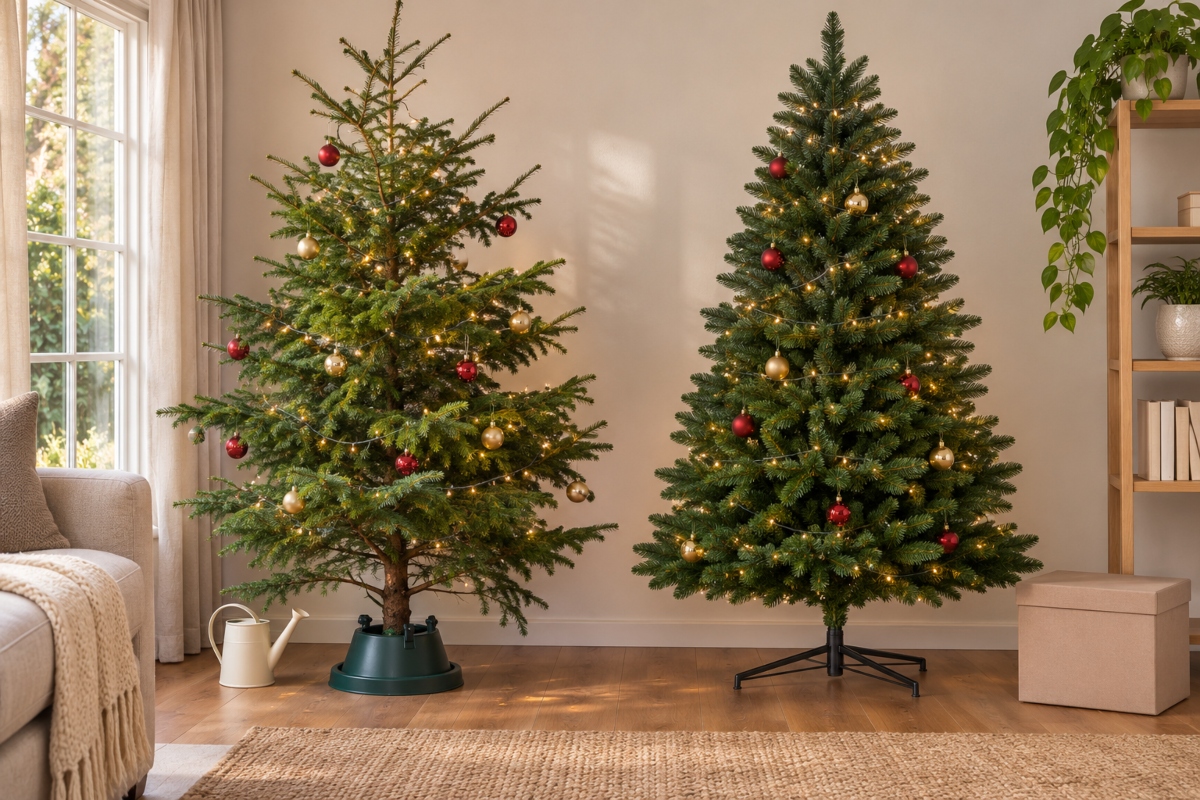
Choosing a natural or artificial tree depends on how much maintenance you can provide, where you’ll place it, and whether you have space to store it after Christmas. The natural option requires water and attention during the season; the artificial can be reused, but needs storage. Before buying, it’s worth comparing these needs with your routine and budget.
It also matters what you’ll do with it when the holidays end. The reuse of artificial trees and the disposal of natural ones after December are part of a decision that goes beyond their appearance.
Natural or Artificial Tree: Start with Your Space
Measure the available space before choosing.
Consider the total height with the star or top decoration, the width of the branches, and the space the base will occupy.
In an apartment, a narrow model can facilitate movement.
If you choose an artificial one, also check the dimensions of its box: the space it occupies when assembled is not the same as what you’ll need to store it for the rest of the year.
For either option, the U.S. Consumer Product Safety Commission recommends keeping the tree away from heat sources and ensuring it doesn’t block doors or walkways.
Natural Trees Require Attention During the Season
If you enjoy selecting a different specimen each year and can dedicate time to care for it, a natural tree may suit your home.
When buying it, check its freshness.
The CPSC notes that needles on a fresh tree should be difficult to remove and not break easily when bent.
Abundant needle shedding when gently tapping the base on the ground can indicate it’s too dry.
Once installed, it needs water.
The Massachusetts Fire Services Department advises watering it daily and removing it once it dries out.
Keeping it indoors means monitoring its condition and cleaning up the needles it sheds.
Artificial Trees Facilitate Reuse
An artificial tree may be suitable if you prefer using the same tree over several seasons and avoiding the daily watering maintenance.
Before choosing one, consider the effort of assembling it, arranging its branches, disassembling it, and storing it.
Look for a label indicating fire resistance.
The CPSC clarifies that this feature means the material offers greater resistance to catching fire, but does not guarantee that it’s impossible for it to catch fire.
If it includes lights, check cables and connections before installing it.
The agency recommends discarding light strings with worn cables or damaged components.
Compare the Complete Cost
Don’t focus solely on the display price.
For natural trees, add the cost of a base with water reservoir, transportation, and any collection fees that may exist in your area.
For artificial trees, consider how many seasons you expect to use it and where you’ll store it.
You can divide its price by the expected years of use to estimate the annual cost, without assuming that all models will last the same length of time.
If you already have one in good condition, including it in the comparison avoids treating a new purchase as a requirement for celebrating.
Environmental Impact Also Depends on Your Decisions
The Nature Conservancy favors natural trees grown for this purpose and highlights that they can be utilized afterward through conservation or recycling programs.
It also notes that most artificial trees are not recyclable.
Meanwhile, the University of Minnesota recommends keeping artificial trees for many years and seeking local producers when buying a natural one.
The practical choice is one you can maintain: natural if you’ll handle its care and final disposal; artificial if you have storage space and plan to reuse it over several Christmases.
Filed as: Natural or artificial tree